
林棟樑 | Don Lin
人類對超越死亡與永生的渴望
細看文天祥的名句「人生自古誰無死, 留取丹心照汗青」, 表明的就是人都難免一死, 但是要留青史. 「留青史」之所以重要, 是因為它超越個人的死亡, 會永遠流傳下去. 要知道,「超越死亡」而達到某種形式的「永生」, 是人類除了「生存」與「繁衍」之外, 最深層, 也是最普遍的本能動機. 多普遍? 這就要看「某種形式的永生」到底是講哪一種形式的永生. 全球人口八十億, 如果講追求「肉體長生不老」的永生, 那就很少, 大約不到1%. 如果講追求「死後靈魂」的永生, 把所有宗教人口算進去, 約有80–85%. 如果更廣義的把 「希望死後能留下某種延續自己的事物」 拿來定義「廣義的永生」的話, 那麼全球90%以上的人類都在追求.
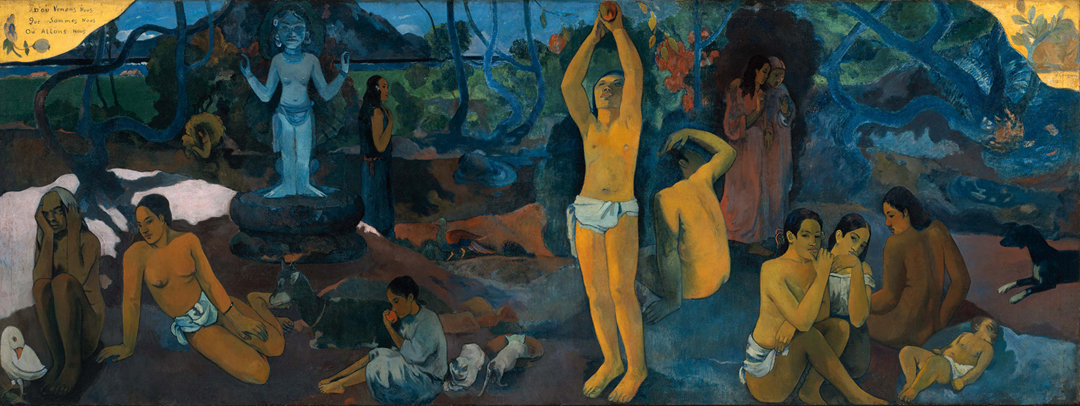
永生, immortality, 顧名思義就是不要mortal, 不要有死亡, 讓生命一直延續下去. 人類是有生命的, 任何有生命的, 終有一死, 因此, 凡是人, 難逃一死. 但是我們都知道, 人類是有極高智慧的物種, 因此,就像文章開頭講的, 人類想方設法想要避免死亡, 超越死亡. 尤其是老年的時候更勤於鍛鍊身體, 並且在LINE的群組廣發五花八門的健康養生video 給親朋好友, 期望大家都能身強體健, 長生不老, 要把死亡push到老遠. 但是三不五時,在夜闌人靜的時候, 會捫心自問: 「我到底是短暫的存在,還是永恆宇宙的一部分? 」在討論人, 存在, 死亡, 永生之前, 我們總要先知道「人是甚麼」, “What are We?” 說到這個, 就會讓人聯想到法國名畫家高更(Paul Gauguin) 1897年在窮苦潦倒, 重病纏身,喪失愛女的三層嚴重打擊, 極端絕望之下所創作的一幅色彩比較黯淡的名畫 (如圖一). 這幅畫的名字就是”Where Do We Come From? What Are We? Where Are We Going?”. 這沉重的追問, 撼動人心. 畫中人物不少, 包括右下角的嬰兒出生, 中間的成年人摘果實, 以及左下角是一個接近死亡, 抱頭沉思往何處去的老婦女.
「人是什麼?」: 對這個深刻的問題, 五千年人類已經用許多不同的角度來探討.
- 神學的角度: 人就是神所創造的 (聖經 創世紀 1:27).
- 道教: 人類是「道」裡面自然流動的一部分。
- 古埃及的信仰: 人類除了肉體之外,還有多種精神層面。
- 天文學的角度: 組成我們身體的原子來自比地球還遠古的星辰;當我們離開後,它們不會消失,而會重新回到宇宙,永遠地存在, 也就是「永生」.
- 生物學的角度: 人類是靈長類動物的一種,經過數十億年的地球生命演化而來。而嬰兒身體原來的原子會在生命成長中不停地被淘汰換新, 到最後原來的原子所剩無幾.
- 哲學角度: 人是理性動物, 有別於其他物種, 人 有「自我意識」, 富有想像力, 會思考「存在」的意義, 也知曉死亡.
- 藝術角度:人的生命過程 — 嬰兒, 成人, 老年, 死亡.
為甚麼絕大多數的人都害怕死亡: 其實並不是每一個人都害怕死亡. 想自殺的人會害怕死亡嗎? 大部分有自殺傾向的人都覺得生命已經沒有什麼意義, 所以自動選擇死亡作為出路. 所以害怕死亡其實是出於熱愛生命. 我們怕死亡是因為怕自己不再存在, 怕失去知覺; 怕與親人永別. 人類有一個共同特性: 有「自我意識」, 不僅知道有一個「我」的存在; 並且這個在有限時間生存的「我」, 居然還會思考到「無限」的未來, 因此, 無可避免地會追問: 「意識」會繼續嗎? 有沒有「靈魂」? 「記憶」會繼續存在嗎? 「自我」會消失嗎? 對這些問題, 從來沒有一個人曾經從死亡那邊回來可以很有自信地告訴你答案是什麼. 所有這些不確定性, 正是讓人恐懼的原因. 人類渴望能得到「永生」, 來克服種種的「怕」, 永遠地避免面對「死亡」. 另一個害怕死亡的原因是因為世界有種種的「愛」, 世界有千絲萬縷的「連結」 , 因為生命太美好, 不願就此告別一切, 不願就這麼「終止」. 在世上的經歷非常珍貴, 值得留念, 想要永無止境地繼續下去. 然而,有精通邏輯的希臘哲學家就提出很有智慧,安慰人心的話,說「死亡存在時,我不存在;我存在時,死亡不存在」。那麼,為何要恐懼死亡呢?」, 但是一般人雖然了解這個邏輯, 卻做不到. 我們活著時, 就常常會害怕這「終將一死」, 「告別一切」的悲慘結局.
面對死亡, 又當如何? 這是自人類有史以來就困惑人類的「大哉問」. 古今中外都一樣, 人生就是一場生老病死的過程, 古代過程短, 現代過程長而已. 五千年前的古埃及人對於死亡, 他們繼承的更久遠的人類習俗, 發展出一系列的信仰, 包括人死後有「來世」(“Afterlife”), 而人有幾個精神元素, 諸如Ka (卡) 是生命力, Ba (巴) 是人格, Akh (阿赫)是靈魂, Ren (倫)是名字. Sheut (舍特)是影子. 他們相信這些精神元素在某些保護下會倖存, 不會因為人死亡就消失. 保護的方法就是先把肉體加以木乃伊化, 然後建造墳墓, 同時放入陪葬品包括食物、財物和珍寶. 而且還要從《亡靈書》中的念咒語來引導亡靈進入來世. 所以, 對古埃及人來講, 死亡並不是一切消失, 而是一個宇宙秩序的「轉折點」 (其他細節, 參看發表在 「海外台灣人筆會」的拙作「法老的永生, 神秘的金字塔與天文」).
跟古代埃及人一樣, 美索不達米亞的古代人也相信有來世. 但是他們的來世是所有死者統統跑進地底深處的黑暗陰森之地的冥界, 他們以塵土和泥土為食,穿著羽毛般的衣裳,就像鳥兒一般在伸手不見五指的黑暗中游盪, 個個非常淒涼. 在世的人也覺得「永生」是沒有希望的. 對來世的全盤悲觀, 讓他們認為人在世的時候, 就要「及時行樂」,否則「後悔莫及」.
古希臘人雖然接受美索不達米亞人對死亡的態度,但是他們也向前推進, 自己發展獨特的信仰. 比如「來世」的出路就分成三種: 英雄與有德之人的是極樂世界式的天堂(Elysium), 大多數普通靈魂去的是草甸(Asphodel Meadows), 懲罰惡人的是集中在另一個叫Tartarus的地方. 雖然希臘哲學家蘇格拉底說,靈魂是不朽的,死亡沒什麼可怕. 但是在荷馬史詩《奧德賽》中,有一句名言"寧願在人間做一個貧窮的奴隸,也不願成為冥界亡靈之王"。對希臘人來說,世間永遠比冥界美好。
東方的中國, 大致上是追隨佛教的想法, 認為人是有靈魂的, 也有來生, 好人的靈魂可以重新回來陽世, 投胎出生, 變做另一個人. 壞人的靈魂回來陽世, 投胎出生, 變做動物, 顯示的就是佛教的核心想法: 人帶一個靈魂出生, 死亡, 再出生(帶著新靈魂), 再死亡的不斷經歷六道輪迴. 要破除生死輪迴, 就必須在智慧上完全看透世間無常、苦、空的本質,破除對肉體與自我的執著,要學會「無我」「忘我」,並且放棄對「永生」的追求因為這種追求會引起無窮煩惱, 除了要斷除自己的煩惱,更要在慈悲上, 發大慈悲心, 廣度普羅眾生, 令智慧與慈悲達到圓滿,便能成就佛道,達到最高境界的涅槃,從此永久解脫生死. 這是佛教的終極目標.
與佛教一樣, 基督教也不認為死亡是終點. 但是基督教的終極盼望是復活與永生. 「永生」 是與上帝連在一起的, 因為上帝是永恆的; 祂沒有開端, 沒有終結. 「永生」是上帝在造人時所給予的福澤之一. 「永生」是沒問題, 因為沒有死亡. 但是「亞當」「夏娃」兩人沒聽上帝的話, 受蛇的引誘, 選擇「墮落」之後 ( 吃了智慧樹的果實), 死亡, 苦難, 以及與上帝的分離就發生了; 這是基督教聖經的創世紀第2章16-17節裡明白描述的. 所以, 死亡是墮落世界的一部分. 被貶入世間, 要無時無刻面對痛苦的死亡, 人類就很掙扎. 然而,上帝慈悲, 指示信徒,要「永生」, 就得需要建立在與上帝的「相互關係」之上; 與神聯合,參與神聖的生命,靈性上的復興,以及與神同在。上帝給了一條實際的路,祂讓唯一兒子 耶穌下凡世,只要信耶穌基督, 就得「永生」. 這個「信我者得永生」的宣示就記載在約翰福音第3章16節裡. 而「永生」的世界不是虛無的天空, 而是「新天新地」的降臨 (啟示錄 21: 1-4).
為什麼渴望永生 (Why): 有幾個層面可以討論:
- 生物進化論的觀點: 不積極想永生的人的基因,比較難傳到下一代.長時間過濾淘汰的結果是 — 「渴望永生」的基因不停地sharpen, 代代相傳, 逐漸累積在後代人的基因裡,「渴望永生」就越來越變成是人的基本性格.
- 心理學的因素: 對「不存在」是極為懼怕, 因此渴望永生.
- 人的意識裡,認為生命要擁有意義 (Meaning),才踏實到位.如果生命是短暫有限的, 死亡後一切都化為「子虛烏有」, 那麼「存在」還有什麼意義? 「追求智慧」還有什麼意義? 「文明推進」還有什麼意義? 「永生」不是為了Survive, 而是為了Meaning.
- 人對世間的眷戀,不願意在世上的種種愛,種種連結,從此滅絕.
- 個人意識上認為,人有靈魂,有來世,有再生,這些信仰,不管是否為真,卻鼓舞無數人對永生的追求.
- 科技的大幅進步,讓很多人覺得好像可以在某些方面實質幫大忙,不是在摸不著邊際的靈魂永生這一塊,而是在個人資訊的永生這一塊.比如AI 能夠創造digital twin, 能看, 能聽, 能即時對話.
人類渴望的是哪一類型的 「永生」(What)? 從物理學的質能不滅定律, 我們都知道曾經住在我們身體上的每一顆原子都不會消滅. 即時人死掉了也是如此. 保證永生. 所以這不是人類尋求永生的項目. 尋求永生的項目一定是那些因為死亡而可能會消失的東西, 比如 「活著」,「自我意識」, 「記憶」, 「靈魂」等等. 人們想方設法讓這些東西不要消失. 比方, 要讓「活著」不要消失, 那麼肉體與靈魂都要一直活下去. (古代「秦始皇」式; 現代「普丁」式. 屬於生物的長生不老); 這是一種. 另一種就是讓死亡自然發生, 但是把死亡看成只是一個「轉折點」,肉體可以「木乃伊」化或腐化, 但靈魂要「永生」. (肉體「木乃伊」化的是古埃及法老式; 肉體可以腐化的是基督教式). 還有其他種種「象徵性」的永生:
- 有自己的小孩, 有孫兒女 , 傳宗接代。
- 傳承 (Legacy): 著書立說,寫科學論文, 創作歌曲,藝術作品, 紀念碑, 建立公司, 科學發明, 建立機構.
- 讓別人記得你: 相片, videos, 家譜, grave marks, memorials來被家人、朋友、社區銘記.
- 歷史: 尋求名聲或持久影響力.
- 藉宗教信仰,相信有天堂、復活、轉世或永恆靈魂來survive death.
- 數位式的永生: 保存照片, 影片, 文字, 人工智慧頭像(Avatar); 與已故個體的模擬進行對話.
- 利用高端生物及藥理科技, 抵抗衰老, 直接延長壽命. 或用人體冷凍學, 保住肉體, 已備後用.
- 藉建築物或基金會的公益奉獻, 間接達成某種形式的永生.
- 精神上的永生: 宗教的信仰(基督教的與神同在,佛教,道教等).
- 影響式的永生: 去當老師,去幫助別人,去服務社會.
為了面對死亡甚至要超越死亡, 我們一般人或多或少做了上面「象徵性」永生的事 (而可能不自覺). 但是死亡並不只限於人類, 連天上的「恆星」都會走向死亡, 因為「油燈耗盡」(也就是燃料用盡) 而死亡.
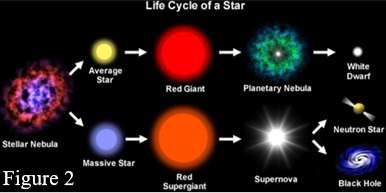
恆星的死亡: 過去百年來我們對宇宙的認識, 可以說突飛猛進. 宇宙的大爆炸, 膨脹, 暗物質 , 暗能量, 全部出籠. 然而, 讓物理學家汗顏的是占宇宙95%的暗物質與暗能量, 除了知道它們不發光, 不反光, 以及只受引力作用外, 其他一無所知. 而會發光讓我們看見的 恆星, 就只占宇宙的5%. 不要小看這5%, 宇宙恆星的總數大約有1022個, 這數目比所有死的與活的人類的總數, 1011, 大約大一千億倍, 超級驚人的數目. 依照質量從大到小, 恆星分七類: O,B,A,F,G,K,M. 我們太陽屬於G類. 要知道, 有燃料的恆星都會有用盡的一天. 這與「 有生命的人, 終有一死」 是類似的. 圖二顯示的是恆星老年期燃料用盡時的情形 (K, M 的小恆星燃燒速度慢, 壽命都比宇宙長, 不討論).
- 塊頭中的恆星(G類) 燃燒速度不挺快, 約100億年生命期, 走的是圖的上面的一條路: 它們的死亡, 不是從氫氫 → 氦→ 碳核融後冷卻,黯淡, 消失, 而是外層變成recycle的星塵, 內層變成白矮星, 白矮星可以漫遊宇宙 超過 1012年.
- 塊頭大的恆星 (O,B,A,F) 燃燒速度快,幾百萬到幾億年生命期, 走的是圖的下面的一條路: 它們的死亡, 也不是消失, 而是內層受不住超大引力而繼續從氫氫 → 氦→ 碳→ 氖→ 氧→ 矽→ 鐵,而鐵的核融不放出能量,反而消耗能量, 造成內層陷蹋成「城市大小」的中子星或黑洞後爆炸,把外層噴出成超級光亮的Supernova, recycle星塵.中子星/黑洞可以漫遊宇宙超過 1030 – 1040年.
這過程說明, 恆星的死亡不是「幻滅」,「結束」,而是另一種更永久存在形式的開始 –百億年壽命的恆星死亡後轉換成可以存在至少幾兆年的白矮星; 而中子星, 黑洞的存在更是不得了的久遠. 「死亡, 是另一種更永久存在形式的開始」, 這是一個深刻的認識, 宇宙透露出的玄機. 恆星是這樣, 那同屬宇宙的人呢?
人死後, 以何種更永久的形式存在: 有幾個角度可以來探討這個更永久的形式:
- 從科學角度來講, 一個人身體上所有的原子 (atoms), 雖然一生中不停地淘舊換新, 但是死後也不會消失, 永遠存在宇宙中, 而人的記憶、人格與意識,目前所知是依賴大腦運作;當大腦永久停止運作後,科學家沒辦法證實這三樣東西會繼續運作; 所以, 人的物質會繼續存在,但個體意識是否以更永久的形式繼續存在,尚無證據, 沒有定論.
- 從古埃及金字塔時代法老的觀點, 死, 只不過是一個轉折點,靈魂升天,結合天上星辰, 或轉變成星星, 才是永生之道.其中的過程需要幾種步驟: 儀式, 肉體木乃伊化, 咒文, 獻禮, 然後死後的審判合格. 所以古埃及人的永生主要指昇入滿天星斗的天界.
- 從宗教(包括基督教,佛教, 印度教)的角度來講, 人有靈魂; 人的肉體可以死亡, 但是靈魂不死. 基督教講同一靈魂, 會復活,最後與神同在才是主旨,與滿天星斗的天界無關,而永生只是by-product; 佛教的靈魂不是永恆不變, 有輪迴, 最後超越輪迴, 達到涅槃; 印度教 認為有永恆的我, 靈魂會轉世.最後會與宇宙合一.
- 從哲學的觀點, 你死後真正留下的是你的影響力, 你的作品, 以及你的形象(在別人的記憶裡 ).
- 從AI的觀點, 你的一切資訊, 包括聲音, 影像, 文字, 電子郵件, 日記, 思想模式等等, 可以數位化後做成Digital Double, 活生生地就等於是這個人的digital twin. 除了"音容宛在"外,還會藉 AI的功能,與活人即時對話,就視覺聽覺的角度來看, digital double就好像「活人」一般.如果digital technology能夠永遠存在, 那麼一個可以看見, 可以即時對話, 活跳跳的「 virtual的你」就永遠存在.
底下的圖表簡單表示這幾種觀點的比較
| 觀點 | 甚麼能永存? | 核心思想 |
| 質能守恆式永生 | 物質與能量 | 構成身體的原子與能量不會消失,而是在宇宙中持續循環. |
| 生物式永生 | 肉體 | 透過醫學, 基因工程, 器官替換等技術延長生命, 甚至消除衰老. |
| 法老式永生 | 靈魂與身份 | 死後升入天界,加入眾神與星辰之中,延續王者的存在. |
| 聖經式永生 | 人格與靈性生命 | 肉體會死亡,但人在神裡獲得永恆生命,最終經歷復活. 星辰是永生榮耀的象徵, 而不是永生本身. |
| 哲學式永生 | 影響力, 作品, 形象 | 哲學家接受死亡是必然;但是有些東西可以超越死亡. |
| 虛擬式永生 | Digital Double | 肉體會死亡,但虛擬的人繼續在digital world裡活著. |
結論:人類對「永生」的渴望,源於對存在意義的深刻追問。在面對死亡的恐懼時, 渴望「永生」是可以理解的. 本文給予「永生」多維解析: 物理學, 生物學, AI, 法老金字塔, 聖經。嘗試回答「死亡之後,什麼才是真正不朽的?」物理學揭示的是物質的延續;生物學追求的是身體的延續;宗教渴望的是生命的延續; 法老追求的是身份的延續。AI追求的是Digital Double的延續。歸根究底,無論如何, 這個「我」是不能夠消失的,所以, 要「精神不朽」 — 我的靈魂永存。要「生物永生」– 我的基因繼續存在。要「文化不朽」– 我的作品仍在繼續。要「社會不朽」– 我被記住了。要「數字不朽」– 我的信息仍在繼續。 我們或許無法確定這些能永垂不朽到甚麼地步,但科學能confirm的是:我們身上的每一個原子,都來自比人類更古老的宇宙,而且還會永遠地存在下去。所以, 雖然文明已進步到21世紀, 人類對「永生」及「存在」意義的深刻追問, 還是會繼續下去, 直到永遠.
<2026-06-13>
Our Desire to Transcend Death and Achieve Immortality
A close examination of Wen Tianxiang’s (文天祥) famous line, “Since ancient times, who has ever escaped death? Let my loyal heart shine in history,” reveals that while death is inevitable, the goal is to leave a lasting mark on history. The importance of “leaving a lasting mark” lies in its transcendence of death, ensuring its eternal existence. This transcendence of death, achieving certain form of “immortality,” is one of humanity’s deepest and most universal instinctual motivations, beyond that of survival and reproduction. How universal? It depends on the specific form of immortality being referred to. With a global population of eight billion, the pursuit of pure “physical immortality” is quite minimal, less than 1%. If we consider the pursuit of “immortality of the soul” after death, including religious individuals, it’s approximately 80-85%. If we define “immortality” more broadly as the desire to leave something behind to perpetuate one’s existence after death, then over 90% of humanity is pursuing it.
Immortality, as the name suggests, means avoiding mortality, eliminating death, and allowing life to continue indefinitely. Humans are living beings, and all living beings are destined to die; therefore, no one can escape death. However, we all know that humans are a highly intelligent species, and thus, as mentioned at the beginning of this article, humans try every means to avoid and transcend death. Especially in old age, they diligently exercise and widely share various health and wellness videos in various LINE chat groups with friends and family, hoping everyone will be healthy and live long lives, pushing death far away. But every now and then, in the quiet hours of the night, they will ask themselves: “Am I a temporary existence, or part of the eternal universe?” Before discussing human beings, existence, death, and immortality, we must first understand “What are we?” This brings to mind the famous French painter Paul Gauguin in 1897, when he was impoverished. Suffering from a severe illness and the devastating loss of his beloved daughter, he created this famous painting (Figure 1) in a state of extreme despair. The painting is titled “Where Do We Come From? What Are We? Where Are We Going?”, a poignant question that deeply moves the viewer. The painting depicts many figures, including a newborn baby in the lower right corner, adults picking fruit in the center, and an elderly woman nearing death, burying her face in her hands, deep in thought about her future.
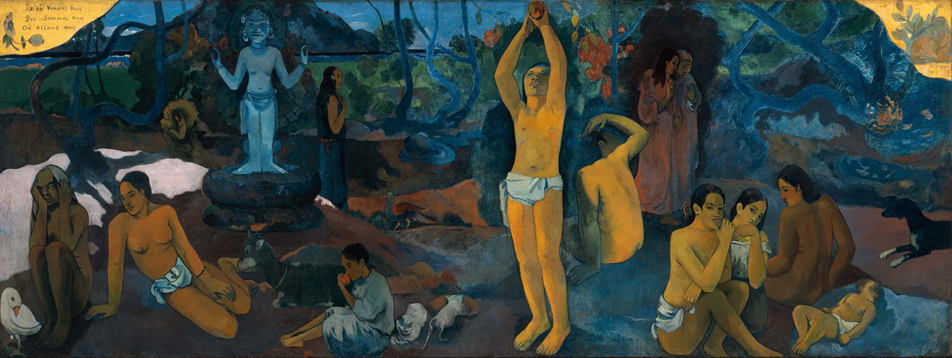
“What is a human being?“: For five thousand years, humans have explored this profound question from many different angles.
- Theological perspective: Man is God’s creation (Bible Genesis 1:27).
- Taoism: Human beings are a naturally flowing part of the Tao.
- Ancient Egyptian beliefs: In addition to the physical body, human beings also have many spiritual aspects.
- Astronomical perspective: The atoms that make up our bodies come from stars that are more ancient than the earth; when we leave, they will not disappear, but will return to the universe and exist forever, which is “eternal life”.
- Biological perspective: Humans are a type of primate that evolved over billions of years on earth. The original atoms in a baby’s body will be constantly eliminated and replaced with new ones as it grows, and in the end, there will be very few original atoms left.
- Philosophical perspective: Humans are rational animals, different from other species. Humans have “self-awareness”, are imaginative, can think about the meaning of “existence”, and are also aware of death.
- Artistic perspective: human life process – infancy, adulthood, old age, death.
Why most people are afraid of death: In fact, not everyone is afraid of death. Are people who want to commit suicide afraid of death? Most people with suicidal tendencies feel that life has no meaning, not worth of living, so they automatically choose death as a way out. So the fear of death is actually out of love for life. We are afraid of death because we are afraid that we will no longer exist, that we will lose consciousness, and that we will be separated from our loved ones. Human beings have a common characteristic: they have “self-awareness”, not only knowing that there is a “me”, but also that this “me” survives in a limited time. He who lives finite time actually can think about the “infinite” future, so he will inevitably ask questions: Will “consciousness” continue? Is there a “soul”? Will “memory” continue to exist? Will “self” disappear? Regarding these questions, no one has ever come back from death and can tell you with confidence what the answer is. All these uncertainties are the reason why people are so scared. Human beings long for “eternal life” to overcome all kinds of “fear” and avoid facing “death” forever. Another reason to be afraid of death is because there are all kinds of “love” in the world and the world is inextricably linked. Because life is too beautiful, I don’t want to say goodbye to everything, and I don’t want to just “end”. The experience in the world is very precious and worth remembering, and I want to continue it endlessly. However, Greek philosophers who are proficient in logic put forward very wise and comforting words, saying, “When death exists, I do not exist; when I exist, death does not exist.” So why fear death? ”, Although most people understand this logic, they cannot do it. When we are alive, we are often afraid of the tragic ending of “dying” and “saying goodbye to everything”.
How should we face death? This is a profound question that has perplexed humanity since the dawn of time. Throughout history and across cultures, life is a process of birth, aging, sickness, and death; the process was shorter in ancient times and longer in modern times. Five thousand years ago, the ancient Egyptians, inheriting even more ancient human customs, developed a series of beliefs about death, including the existence of an “Afterlife.” They believed that humans possess several spiritual elements, such as Ka (life force), Ba (personality), Akh (soul), Ren (name), and Sheut (shadow). They believed these spiritual elements would survive under certain protection and would not disappear upon death. This protection involved mummifying the body, building a tomb, and placing burial goods including food, valuables, and treasures. Furthermore, they believed incantations from the Book of the Dead to guide the spirit into the afterlife. Therefore, for the ancient Egyptians, death was not the disappearance of everything, but a “turning point” in the cosmic order ( For other details, please see my article “The Pharaoh’s Immortality, the Mysterious Pyramids, and Astronomy,” published in the “Overseas Taiwanese Pen Club” website — taiwanpenclub.org).
Like the ancient Egyptians, the ancient Mesopotamians also believed in an afterlife. However, their afterlife was a dark and gloomy underworld where all the dead fled to the depths of the earth. They fed on dust and mud, wore feather-like garments, and wandered like birds in the pitch-black darkness, each one utterly desolate. Those still alive felt that “immortality” was hopeless. This complete pessimism about the afterlife led them to believe that while alive, one should “seize the day,” otherwise “it will be too late to regret.”
While the ancient Greeks accepted the Mesopotamian attitude towards death, they also progressed, developing their own unique beliefs. For example, the paths to the “afterlife” were divided into three: for heroes and virtuous people, it was a paradise-like heaven (Elysium); for most ordinary souls, it was the meadow (Asphodel Meadows). The punishment of evildoers was concentrated in another place called Tartarus. Although the Greek philosopher Socrates said that the soul is immortal and death is nothing to fear, there is a famous line in Homer’s epic poem, the Odyssey: “I would rather be a poor slave on earth than the king of the dead.” For the Greeks, the world was always better than the underworld.
In China, the Buddhist view is largely followed in which people believe that humans possess a soul and are subject to reincarnation. The souls of good people can return to the mortal world, be reborn, and become another person. The souls of bad people return to the mortal world, are reborn, and become animals. This reflects the core Buddhist idea: a person is born with a soul, dies, is reborn (with a new soul), and dies again, continuously experiencing the six realms of reincarnation. To break free from this cycle of birth and death, one must fully understand the impermanent, suffering, and empty nature of the world, break free from attachment to the physical body and self, learn “no-self” and “forgetting oneself,” and abandon the pursuit of “eternal life,” as this pursuit will cause endless suffering. Besides eliminating one’s own suffering, one must cultivate great compassion, widely benefiting all sentient beings, so that wisdom and compassion reach perfection, thus achieving Buddhahood and reaching the highest state of Nirvana, thereby permanently liberating oneself from birth and death. This is the ultimate goal of Buddhism.
Like Buddhism, Christianity also does not consider death to be the end. However, the ultimate hope of Christianity is resurrection and eternal life. “Eternal life” is connected to God, because God is eternal; He has no beginning and no end. “Eternal life” is one of the blessings God bestowed upon humankind at creation. “Eternal life” itself is not problematic, because there is no death. However, Adam and Eve disobeyed God’s command, succumbed to the serpent’s temptation, and chose to “fall” (eat the fruit of the tree of knowledge). Death, suffering, and separation from God then occurred; this is clearly described in Genesis 2:16-17 of the Christian Bible. Therefore, death is part of the fallen world. Being banished to the world and facing the pain of death at all times is a struggle for humanity. However, God, in His mercy, instructs believers that “eternal life” must be built upon a “relationship” with God; union with God, participation in divine life, spiritual revival, and being in His presence. God provided a practical way: He sent His only Son, Jesus, to earth. Anyone who believes in Jesus Christ will attain “eternal life.” This declaration of “whoever believes in me will have eternal life” is recorded in John 3:16. And the world of “eternal life” is not a void sky, but the coming of the “new heaven and new earth” (Revelation 21:1-4).
Why the Desire for Immortality (Why): Several aspects can be discussed:
- From the perspective of biological evolution: The genes of those who don’t actively desire immortality are less likely to be passed on to the next generation. The result of long-term filtering and elimination is that the gene for “desire for immortality” is constantly sharpened, passed down through generations, and gradually accumulates in the genes of future generations, making “desire for immortality” increasingly a fundamental human characteristic.
- Psychological factors: There is an extreme fear of “non-existence,” hence the desire for immortality.
- In human consciousness, life needs meaning to feel fulfilled. If life is short and finite, and everything becomes “nothingness” after death, then what is the meaning of “existence”? What is the meaning of “the pursuit of wisdom”? What is the meaning of “the advancement of civilization”? “Immortality” is not for survival, but for meaning.
- Human beings’ attachment to the world, their unwillingness for all the love and connections they have in this world to be extinguished.
- The belief that humans possess a soul, an afterlife, and rebirth, regardless of its veracity, inspires countless people in their pursuit of immortality.
- Significant technological advancements have led many to believe that these advancements can offer substantial assistance in certain areas, not in the elusive realm of spiritual immortality, but rather in the immortality of personal information. For example, AI can create digital twins that can see, hear, and engage in real-time conversations.
What kind of “immortality” does humanity crave? From the law of conservation of mass-energy in physics, we know that every atom that once lived in our bodies will not be destroyed, even after death. This guarantees immortality. Therefore, this isn’t an item for which humanity seeks for immortality. Items that people seek for immortality are those things that might disappear with death, such as “living,” “self-awareness,” “memory,” and “soul.” People try every means to prevent these things from disappearing. For example, to prevent “living” from disappearing, both the body and soul must live on indefinitely (e.g., the ancient “Qin Shi Huang” type; the modern “Putin” type, belonging to biological immortality). This is one type. Another is to let death occur naturally, but to see death as merely a “turning point.” The body can be “mummified” or decay, but the soul must be “immortal” (e.g., the ancient Egyptian pharaohs’ practice of mummification; the Christian approach of allowing the body to decay). There are also various other “symbolic” forms of immortality:
- Having children and grandchildren, continuing the family line.
- Legacy: Writing books, scientific papers, composing songs, creating artwork, erecting monuments, establishing companies, making scientific inventions, and setting up institutions.
- Remembering You: Photos, videos, family trees, grave marks, and memorials to be remembered by family, friends, and community.
- History: Seeking fame or lasting influence.
- Immortality through religious beliefs, such as heaven, resurrection, reincarnation, or eternal souls, to survive death.
- Digital immortality: preserving photos, videos, text, and AI avatars; engaging in dialogue with simulations of deceased individuals.
- Utilizing advanced biological and pharmacological technologies to resist aging and directly extend lifespan. Or using cryonics to preserve the body for future use.
- Achieving some form of immortality indirectly through charitable donations to buildings or foundations.
- Spiritual immortality: religious faith (Christianity’s communion with God, Buddhism, Taoism, etc.).
- Immortality through impact: becoming a teacher, helping others, or serving society.
In order to face death and even transcend it, most of us have done more or less of the above-mentioned “symbolic” acts of immortality (perhaps unconsciously). However, death is not limited to humans; even the “stars” in the sky will eventually die because their “oil lamp runs out” (i.e., they run out of fuel).
The Death of Stars: Our understanding of the universe has advanced by leaps and bounds over the past century. The Big Bang, expansion, dark matter, and dark energy have all been revealed. However, what makes physicists blush is that we know nothing about dark matter and dark energy, which make up 95% of the universe, except that they do not emit or reflect light and only interact through gravity. Stars, which emit light and are visible to us, account for only 5% of the universe. Don’t underestimate this 5%; the total number of stars in the universe is approximately 1022, a number about a hundred billion times larger than the total number of all living and dead humans, 1011; a hundred billion is an astonishing number. Stars can be categorized into seven classes according to their masses, from largest to smallest: O, B, A, F, G, K, and M. Our Sun belongs to class G. It’s important to understand that stars with fuel will eventually run out. This is similar to the inevitable death of living beings. Figure 2 shows the state of a star in its old age when its fuel is exhausted (small stars of classes K and M burn slowly; these stars have lifespans longer than the universe, so they won’t be discussed further).
- Mid-sized stars (Class G): Their burning rate isn’t very fast, with a lifespan of about 10 billion years. They follow the path shown at the top of the diagram: their death isn’t a process in which the all the fuel burned up and then the cooling, dimming, and everything disappears. Instead, their outer layers become recycled stardust, and their inner layers become white dwarfs. White dwarfs can roam the universe for over 10¹² years.
- Large stars (O, B, A, F): Their burning rate is fast, with a lifespan of several million to several hundred million years. They follow the path shown at the bottom of the diagram: their death isn’t disappearance either. Instead, their inner layers can’t withstand the immense gravity and the burning stops at iron. The fusion of iron doesn’t release energy but consumes it, causing the inner layers to collapse into a “city-sized” neutron star or black hole before exploding, ejecting the outer layers as a super-bright supernova which becomes recycling stardust. Neutron stars and black holes can roam the universe for over 1030-1040 years.
This process illustrates that the death of a star is not “disillusionment” or “the end,” but rather the beginning of another, more permanent form of existence—stars with lifespans of billions of years transform into white dwarfs that can exist for at least trillions of years; and the existence of neutron stars and black holes is even more incredibly long-lasting. “Death is the beginning of another, more permanent form of existence”—this is a profound realization, a mystery revealed by the universe. If this is true for stars, what about humans, who also belong to the universe?
In what more permanent form does a person exist after death? Several perspectives can be used to explore this more permanent form:
- From a scientific perspective, all the atoms in a person’s body, although constantly being replaced throughout life, do not disappear after death but exist eternally in the universe. However, human memory, personality, and consciousness, as we currently know, depend on brain function. When the brain permanently ceases to function, scientists cannot prove that these three things will continue to operate. Therefore, a person’s body constituents continue to exist, but whether individual consciousness continues in a more permanent form is still unproven and inconclusive.
- From the perspective of the pharaohs of ancient Egypt’s pyramid era, death was merely a turning point. The soul ascended to heaven, uniting with the stars, or transforming into a star—this was the path to immortality. This process required several steps: rituals, mummification, incantations, offerings, and then passing a judgment after death. Therefore, the ancient Egyptians’ concept of immortality primarily referred to ascending to the celestial realm filled with stars.
- From a religious perspective (including Christianity, Buddhism, and Hinduism), humans possess a soul; the physical body can die, but the soul is immortal. Christianity emphasizes the same soul, resurrection, and ultimately, union with God, which is unrelated to the celestial realm of stars, and immortality is merely a byproduct. Buddhism views the soul not as eternally unchanging, but as subject to reincarnation, ultimately transcending reincarnation to achieve Nirvana. Hinduism believes in an eternal self, with the soul reincarnating and ultimately merging with the universe.
- From a philosophical perspective, what you truly leave behind after death is your influence, your works, and your image (in the memories of others).
- From an AI perspective, all your information, including voice, images, text, emails, diaries, thought patterns, etc., can be digitized into a Digital Double, essentially a digital twin of that person. Besides being “visually present,” it can also utilize AI capabilities to engage in real-time dialogue with the living; from a visual and auditory perspective, the Digital Double is like a “living person.” If digital technology can exist forever, then a “virtual you” that can be seen, interacted with in real time, and is alive will also exist forever.
The chart below simply compares these viewpoints:
| Viewpoint | What can last forever | Core Idea |
| Mass-Energy Conservation Immortality | Matter and Energy | The atoms and energy that make up the body do not disappear but continue to circulate in the universe |
| Biological Immortality | Physical Body | Life is extended through medicine, genetic engineering, organ replacement, and other technologies, even eliminating aging |
| Pharaonic Immortality | Soul and Identity | After death, one ascends to the heavens, joining the gods and stars, continuing the existence of a king |
| Biblical Immortality | Personality and Spiritual Life | The physical body dies, but one gains eternal life in God and ultimately experiences resurrection. The stars are symbols of eternal glory, not immortality itself. |
| Philosophical Immortality | Influence, Works, Image. | Philosophers accept that death is inevitable; however, some things can transcend death |
| Virtual Immortality | Digital Double | The physical body dies, but the virtual person continues to live in the digital world |
Conclusion: Humanity’s desire for “immortality” stems from a profound questioning of the meaning of existence. The desire for “immortality” is understandable when facing the fear of death. This article offers a multi-dimensional analysis of “immortality”: physics, biology, AI, the Pharaoh’s pyramids, and the Bible. It attempts to answer the question, “After death, what is truly immortal?” Physics reveals the continuation of matter; biology pursues the continuation of the body; religion yearns for the continuation of life; the Pharaohs pursued the continuation of identity; AI pursues the continuation of digital double. Ultimately, this “I” cannot disappear, therefore, we need “spiritual immortality”—my soul will live on forever. We need “biological immortality”—my genes will continue to exist. We need “cultural immortality”—my works will continue. We need “social immortality”—I will be remembered. We need “digital immortality”—my information will continue. We may not be able to determine the extent to which these things will achieve immortality, but we are certain that every atom in our bodies comes from a universe older than humanity and will continue to exist forever. Although civilization has progressed into the 21st century, humanity’s profound inquiry into the meaning of “immortality” and “existence” will continue forever.
<2026-06-13>