
Jung Tsai
Did you just blink, smile, or read my opening sentence? If so, congratulations—your muscles are working! We literally cannot have a life without them. Your body houses three types of “meat”: 1, Cardiac Muscles: The ultimate overachievers. They’ve been beating since three weeks after conception and won’t take a single coffee break until the day you die. 2, Smooth Muscles: The behind-the-scenes crew. They handle your digestion and give you goosebumps when you’re watching a horror movie. 3, Skeletal Muscles: the protagonist of today. They attached to your bones by tendons, those guys provide the strength and movement that allow you to do everything from running a marathon to reaching for the TV remote.
We have a bit of an obsession with muscles. We use idioms like “flexing your muscles,” “ruling with an iron fist,” or the “long arm of the law.” We equate muscle with power, success, and—thanks to fitness magazines—a terrifyingly low body-fat percentage.
Your body consists of 630 muscles, with 45 of them in your face alone. This means if you want to have a social life for just a smile you need your muscles. But beyond looking good in a tank top, your health depends heavily on these fibers.How the Magic Happens? Muscles are basically sophisticated rubber bands. They operate on four principles: Excitability: They get “excited” by nerves. Contractility: They can shorten. Extensibility: They can stretch. Elasticity: They snap back to their original shape.
Interestingly, muscle is the only organ you can physically grow larger through hard work. You can’t make your brain cells bigger by thinking really hard (trust me, I’ve tried), but you can bulk up a bicep. Muscle cells are also unique because they refuse to divide, and they are packed with multiple nuclei. A single four-inch leg cell can contain over 3,000 nuclei and a massive amount of mitochondria—the “power plants” of the cell.
At the molecular level, movement is a chemical-to-mechanical magic trick performed by two proteins: Actin and Myosin.
Think of a Viking ship. Myosin is the ship, filled with rowers facing each other on each side. Actin acts as the caps on outside of either end of the ship. When energy is released, the Myosin “rowers” pull toward the Actin caps, shortening the entire unit by about 25%. This process generates heat and carbon dioxide. This “molecular exercise” was so fascinating that Otto Meyerhof and Archibald Hill won the Nobel Prize for it in 1922.
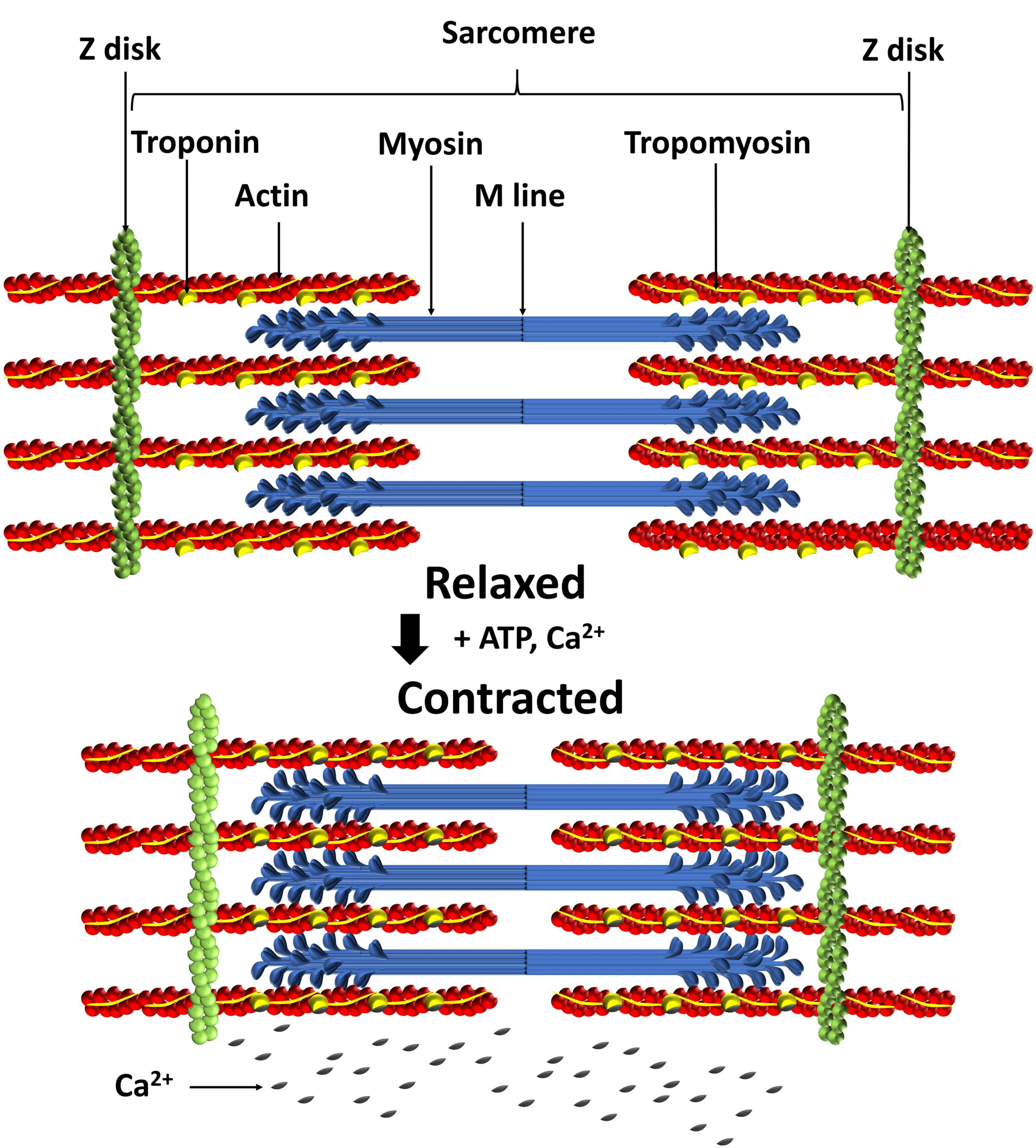
Ever wonder why turkey has white and dark meat? It’s all about the “twitch”: Fast Twitch (White Meat): Used for quick bursts of power (like a turkey trying to fly… poorly). It demands ATP. Slow Twitch (Dark Meat): Built for endurance. These fibers are rich in myoglobin, which turns brown when cooked. This is why migratory birds, who fly for days, have dark meat in their wings and breasts. Humans are the same! A sprinter trains for fast-twitch power, while a marathoner cultivates slow-twitch endurance.
The “Big Problem”: Sarcopenia.
Here is the part where I stop being funny for a second: Muscle mass peaks at age 30. After that, it’s a slow, sliding decline that picks up speed every decade.
When we lose muscle, we don’t just lose “guns” we lose our six senses of movement—our receptors for position, strength, trigger, command, balance and muscle memory. If your breathing muscles fail, you get pneumonia. If your swallowing muscles fail, you need a feeding tube. If no trigger, yell won’t help your muscle’s tension. If loss command, you will have no confidence.If your balance muscles fail, you break a hip. Statistically, 20% of hip surgery patients die within one year of the procedure. Absence of muscle memory, there were never have 3 pointer ,curve ball pitch and forget about playing musical instruments etc. Losing muscle isn’t just about aging; it’s about losing the ability to care for yourself.
The Good News: You don’t have to vanish! You can slow the decline of Sarcopenia. It is never too late to start. By combining resistance training (lifting heavy-ish things) with a high-protein diet and quality supplements, you can keep your “Viking rowers” moving for a long, happy life.
Next report will be an action professional plan for how to to slow down the Sarcopenia.
<2026-03-02>