
林棟樑 | Don Lin
法老的永生, 神秘的金字塔與天文
古埃及, 這個人類有史以來第一個用象形文字的古代文明, 五千多年前坐落在非洲北部, 「尼羅河」畔三角洲地帶. 沿綿了33個王朝. 他們發展出文字, 數學, 還有天文. 法老 (古埃及的統治者) 在約四千七百年前開始建造金字塔. 人類能進步到在那麼古老的時代, 建造這麼體積龐大的金字塔且方向精確無比地朝正北方 (方向的誤差只有0.05度),也真是奇蹟.
至於為什麼要建造金字塔, 這就得追溯到古埃及人對生命的看法. 古埃及人將人生視為永恆旅程中的一個階段,而不是出生到塵世, 過了一生, 死亡後就甚麼都沒有了。塵世的生命固然重要,但對古埃及人來講, 它只是為更為漫長的來世做準備 (東方文化認為, 人有靈魂可以轉世再生, 可能受到古埃及人的影響)。 生命是宇宙秩序 (Cosmic Order) 的一部分; 古埃及人把宇宙秩序叫做「瑪阿特」(Ma’at), 是代表 –真理、平衡、秩序、和諧、法律、道德和正義。「瑪阿特」被擬人化為女神, 頭上插著一根鴕鳥羽毛。人死後,冥界之神,「歐西里斯」 (Osiris) 會將人的心臟與「瑪阿特」的羽毛用秤量一量。若是輕盈(品德高尚),就得永生。若心懷罪惡,就是滅亡。所以,日常生活中的道德行為至關重要。此外,他們認為人由多個部分組成:「卡特」(Khat)是肉體,「卡」(Ka)是生命力,「巴」(Ba)是人格及靈魂,「阿赫」(Akh)是轉化後的靈魂。 保存身體(木乃伊化)至關重要,這樣「卡」和「巴」才能重新結合。死亡只是一種過渡, 只是一個「轉折點」,而非終點。他們有《亡靈書》(Book of Dead)之類的經文, 刻在墳墓牆上,指引著逝者在來世的旅程。這些對肉體生命靈魂的看法, 發生在基督教誕生以前2500年的古埃及時代. 雖然對生命靈魂的看法大致上保持一致, 但是對肉身的看法卻有極大的不同: 古埃及人相信, 死之候雖然靈魂離開, 但是必須與木乃伊的肉體保持連結才能獲得永恆. 不過70多天的木乃伊製作, 大概太過繁複, 所以2500多年後的基督教教義, 就讓肉體可以腐壞, 但是上帝在末日時會賜給一個榮耀的肉體, 會與靈魂結合而得永生. 不過對靈魂回歸天家的重視與渴望, 卻是相同的.
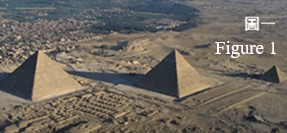
古埃及人把「法老」視為派下凡塵的神明,是統治者,維護著人間的「瑪阿特」。古埃及社會等級森嚴,但每個角色都維繫著宇宙的平衡。家庭生活、工作和職責都是神聖不可侵犯的。一句話概括: 古埃及人認為,人生是通往永生的一個階段,死亡不是生命的黑暗終點,沒有什麼可怕,永生才是目的,這是神聖的宇宙秩序。所以,古埃及人相信, 肉體雖死亡, 但是靈魂會繼續重生, 永恆的星辰就是靈魂的歸宿, 他們相信法老的靈魂死後會升天,與永恆的星辰結合。金字塔的興建就是法老為自己準備的陵寢,是一個發射台, 是靈魂回歸途徑的跳板.而陵寢規模最大的, 是古埃及「第四王朝」的法老「庫夫」( Khufu) 的金字塔, 位於開羅 (Cairo) 西南約10公里的「吉薩」(Giza) 高地, 又叫「吉薩大金字塔」(圖一有3個金字塔, 左邊最大的就是法老「庫夫」 的金字塔. 中間的是他的兒子Khafre的金字塔; 最右邊最小的是他的孫子Menkaure的金字塔)
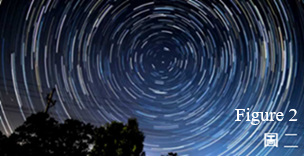
雖然古埃及人認為星是永恆的, 但是經天象的觀測, 知道星星都在繞同心圓 (一天繞一圈;只是太陽一出來星光都被淹沒掉),也就是說, 星星越靠近北部天空的某一點, 其圓圈越小 (圖 二). 對古埃及人來講, 那一點是絕對的永恆不朽. 這種觀念, 不分中外; 在後來中國的「紫微斗數」中也深信不疑, 因為「紫微星」就是「北極星」, 在「紫微斗數」發展的北宋時期 (西元960-1127年), Polaris (亮度1.97)正好就是位在「北極」的那顆星, 它終年不動, 「北極星」是「帝星」, 而眾星拱繞它轉. 所以「紫微星」具有崇高, 無以倫比的地位. 「紫微星」在命盤12宮的哪一宮, 對命盤的運勢至關重要. 所以有「帝星動則列宿奔馳」 的說法.
古埃及人建造金字塔是在西元前2686年到西元前2181年. 比北宋時期早了三千多年. 中國那時大約是處於「新石器時代」晚期. 建造金字塔的那段時候, 星星繞的同心圓的圓心在「天龍座」(Draco) 的Thuban星 (「右樞星」) 附近. 但是其亮度只有3.65, 肉眼難看到. 建築一個大字塔的陵寢, 準確地朝向這個「永恆之點」, 對法老和古埃及人又是至關重要, 馬虎不得, 所以如何找到並無比精確地對準它, 就在考驗著古埃及人對幾何及星象的精確了解與掌握.
金字塔以正方形為底座,體現了他們對穩定結構和幾何學的掌握. 這也與其「方錐體」的設計相呼應,象徵著堅固與永恆. 金字塔對準方位, 體現法老的信仰與宇宙觀的結晶,將來世的永恆與天上的星辰緊密聯繫起來.
金字塔的建構富有各種不同意義. 高聳向天是代表靈魂要回到天上. 所以塔間向上空突出, 而不是像東方, 陵寢在地下. 古埃及人看天象, 認為北極附近的星不曾繞到地平線之下, 而地下是有地嶽的味道, 所以北極附近的星是不朽的(“imperishable”); 不會繞到地平線之下的星星, 統統叫做拱極星(Circumpolar Stars); 對住在埃及開羅的人來講, 拱極星就是那些赤緯Declination超過60o以上的所有星星. 大金字塔的建築一定要非常準確的朝正北的方向. 也就是說要非常準確的朝向天球的北極.對現代人來講,北極就是「北極星」Polaris所在的那一點,小北斗(Little Dipper)勺柄的末端就是Polaris這顆星,很容易找到.但是在4-5千年前,Polaris偏離北極頗遠.北極那一點附近並沒有什麼閃亮的星. 古埃及人要定位北極,不那麼簡單.
古埃及人如何利用天文找到正北方
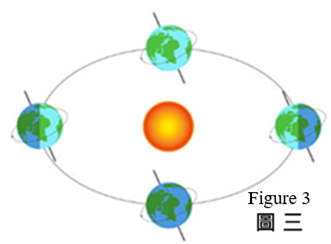
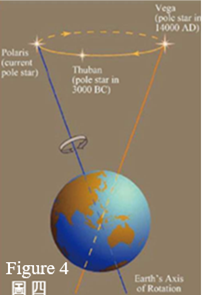
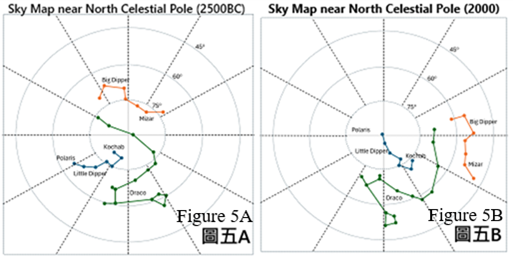
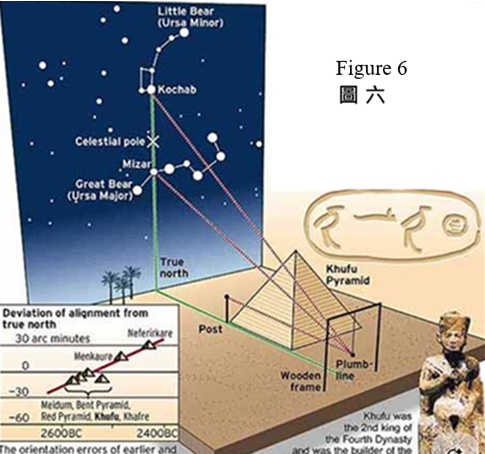
由於天文學的進步, 現代人知道地球其實是繞著太陽在做公轉, 而地球本身在做自轉 (圖 三). 北極是地球自轉軸指向天球的那一點 (圖 四).我們也知道地球就跟陀螺一樣,會一邊轉一邊晃動.這現象叫「進動」(Precession;). 陀螺自轉軸的「進動」,晃一圈大約3-4秒.地球自轉軸的「進動」,晃一圈大約2萬6千年, 在天球上畫出一個圓圈(see 圖四的上方).地球自轉軸之所以會產生「進動」, 主要是由於地球並不是完美的球形;它的肚子(赤道)比較隆起.月球和太陽對地球赤道的隆起,產生引力的差矩而引起Precession (天文物理學可以算出「進動」的週期是26000年).既然2萬6千年晃一圈 (360度),那麼建築「大金字塔̀」離現在也已有4-5千年了, 也晃動了約62度, 剛好就把北極晃到Polaris的位置(圖 四).利用現代天文學的知識, 可以算出金字塔時代 (2500BC) 北極附近的星座圖, 如圖 5A所示, 用與比較現在 (Year 2000) 的星座圖(圖5B). 兩個圖, 除了三個星座(分別為「小北斗」Little Dipper, 「大北斗」Big Dipper與「天龍座」Draco)以外,都有三個維度各別為45o, 60o, 75o的圓圈. 維度90o 的那一點就是北極. 從圖5B, 就明顯可以看出在2500BC, 「北極星」Polaris離北極其實是蠻遠的. 所以古埃及人看北極, 那個時代的極星,不是明亮的Polaris (亮度為2.02), 而是「天龍座」較黯淡的「右樞星」(Thuban; 亮度只有3.65). 所以古埃及人就利用靠近北極點比較明亮的兩顆星來找出北極的位置. 這兩顆星就是「小北斗」的Kochab (亮度為2.08),及「大北斗」的「開陽星」Mizar (亮度為2.27): 北極點就非常靠近這兩星的連結線. 金字塔的建築師在夜晚時觀測這兩顆星,當它們在天空中垂直對齊的時候 (圖 六), 懸一條鉛垂線, 然後人站在鉛垂線後, 利用視線的調整(移動眼睛), 讓鉛垂線看起來與這兩顆星重疊, 這就是正北方向. 聽說古埃及人就是用這種方法來建造金字塔西方的那一面的地基, 來line up正北方, 誤差僅只有0.05度.
大金字塔內的南北通氣孔道對準北極及「獵戶座」
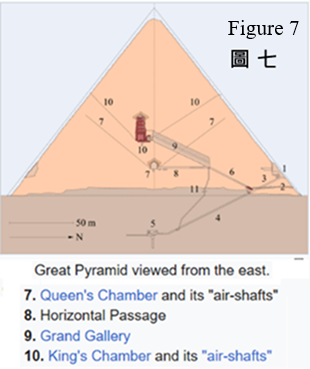
上面提到的「歐西里斯」在古埃及的神話裡有一個重要的故事. 他是大地之神「蓋布」(Geb)和天空女神「努特」(Nut)的兒子, 後來成為埃及國王, 與「伊西斯」Isis結為夫妻. 「歐西里斯」後來被他的一個兄弟害死, 屍體肢解,散落到埃及各地, 「伊西斯」走遍埃及各地,尋找丈夫遺體的碎片。將它們重新縫合, 還用魔法短暫地使「歐西里斯」復活。(這是人類歷史上最早的關於死亡後能復活的神話). 「歐西里斯」沒有返回人間統治, 他死後統治冥界; 根據金字塔銘文, 他的靈魂升入天空,化作「獵戶座」Orion. 因此「歐西里斯」就象徵著:復活, 永生, 道德, 正義, 生死輪迴. 死去的法老個個都渴望成為「歐西里斯」. 這個神話不只是一個故事,更是一個宇宙真理:死亡並非終結, 遺體必須保存(木乃伊化), 生命是更大循環的一部分. 在古埃及, 每個逝者都希望在「來世」成為「歐西里斯」。這種信仰也在大金字塔的建構裡面表現出來. 圖七的大金字塔裡, 有一個是國王的陵寢房間 (King’s Chamber), 另一個是皇后的陵寢房間 (Queen’s Chamber). 每個陵寢都有兩個通氣孔(Air Shaft),一個在北邊,一個在南邊. 北邊空氣孔道的方向是指向北極; 南邊空氣孔道的方向就是指向「獵戶座」腰帶. 這種指向, 代表靈魂要回歸天上的北極以及「獵戶座」, 完成「永生」.
日出前「天狼星」的升起與尼羅河的氾濫
我們現在知道地球是繞著太陽在轉. 但是古代的埃及人他們在地球上只知道地球不動, 太陽是繞一個叫「黃道」(Ecliptic) 的軌道在天空中每年循環一次. 在「黃道」一圈附近分佈有12宮, 也就是西洋人講的12 Zodiacs. 太陽在一年之內就一一訪問了這12宮, 年年如此. 當我們從地球上看, 如果一顆星藏在太陽背後, 我們是看不到這顆星的, 因為太陽在東方升起時,這顆星也在東方升起, 只是陽光太強, 星光太弱, 必然看不見這顆星, 但是太陽在「黃道」上是在慢慢地移動. 本來藏在太陽背後的星, 就不再藏在太陽背後, 慢慢會比太陽早一點升起. 等到這顆星與太陽的角距離夠遠, 我們就可以在凌晨太陽還沒升起時看到這顆星. 這種現象叫「偕日昇」(Heliacal Rising). 古代埃及人觀看天上那顆最亮的「天狼星」時, 發現當它處於「偕日昇」(在凌晨可以看到) 時, 都是「尼羅河」開始氾濫成災的時候. 對古埃及人來講, 「尼羅河」氾濫成災是好事, 因為氾濫為田地帶來了肥沃的黑色淤泥。這種肥沃的土壤使原本沙漠化的土地上能夠進行農業生產, 養育千萬人民。這便構成了一個強大的象徵體系:「天狼星」(與「伊西斯」女神相關) 出現在凌晨的東方時, 洪水帶來黑色淤泥, 使土地肥沃, 孕育生命的重生, 河流的循環反映了死亡與復活的神話。
結論
「吉薩大金字塔」的建造者將精確的天文知識融入設計之中,反映了一種將天象與王權緊密相連的世界觀。這些金字塔幾乎完美地指向正北方向。「古王國時期」的文獻將逝去的法老與「獵戶座」(Orion)聯繫起來,「獵戶座」被認為是「歐西里斯」(Osiris) 的象徵;而「天狼星」 的升起則與「尼羅河」氾濫和農業復興相吻合, 象徵天上的星象直接主宰著地上的生命(i.e., astrology/紫微斗數)。大金字塔內部的狹窄通風道指向特定的星辰,象徵性地引導國王的靈魂升向北方天空中永恆不滅的星辰和南方的「獵戶座」。因此,這些金字塔不僅是宏偉的陵墓,也是通往宇宙的門戶,將大地、天空、王權和永生融合於一體。
<2026-03-18>
Pharaohs’ Immortality, Mysterious Pyramids and Astronomy
Ancient Egypt, the first civilization in human history to use hieroglyphics, was located in North Africa, in the Nile Delta region, more than 5,000 years ago. It spanned 33 dynasties. They developed writing, mathematics, and astronomy. The pharaohs (rulers of ancient Egypt) began building the pyramids approximately 4,700 years ago. It is truly a miracle that humanity could progress to the point of building such massive pyramids in the ancient era, with an incredibly precise orientation of true north (an error of only 0.05 degrees).
As for why the pyramids were built, this traces back to the ancient Egyptians’ view of life. The ancient Egyptians viewed life as a stage in an eternal journey, not simply being born into this world, living a full life, and then dying. While earthly life was important, for the ancient Egyptians, it was merely the preparation for a longer afterlife (Eastern cultures believe in the soul’s ability to reincarnate, possibly influenced by the ancient Egyptians). Life was part of the cosmic order; the ancient Egyptians called this cosmic order “Ma’at”, representing truth, balance, order, harmony, law, morality, and justice. Ma’at was personified as a goddess, with an ostrich feather in her hair. After death, Osiris, the god of the underworld, would weigh the person’s heart against the feather of Ma’at. If the heart was light (of high virtue), eternal life would be granted. If the heart was sinful, destruction would follow. Therefore, moral conduct in daily life was of paramount importance. Furthermore, they believed that a person is composed of multiple parts: “Khat” is the body, “Ka” is life force, “Ba” is personality and soul, and “Akh” is the transformed soul. Preserving the body (mummification) is crucial so that “Ka” and “Ba” can reunite. Death is merely a transition, a “turning point,” not an end. Ancient Egyptians had scriptures such as the Book of the Dead, inscribed on tomb walls, guiding the deceased on their journey to the afterlife. These views on the soul and the physical body predate the birth of Christianity by at least 2500 years. While their views on the soul and life were largely consistent, their views on the physical body differed greatly: the ancient Egyptians believed that although the soul departs at the time of death, it must remain connected with the mummified body to attain eternity. However, the 70-plus-day mummification process was likely too complicated, so Christian doctrine, more than 2500 years later, allows the body to decay, but God will bestow a glorious body at the end times, which will unite with the soul to attain eternal life. Nevertheless, the emphasis on and longing for the soul’s return to heaven remains the same.
The ancient Egyptians viewed the Pharaoh as a deity sent to earth, a ruler who maintained the earthly realm of Ma’at. Ancient Egyptian society was strictly hierarchical, yet each role maintained the balance of the universe. Family life, work, and responsibilities were all sacred and inviolable. In short, the ancient Egyptians believed that life was a stage on the path to immortality; death was not the dark end of life, nothing to fear, but immortality—this was the sacred cosmic order. Therefore, the ancient Egyptians believed that although the body died, the soul would continue to be reborn, and the eternal stars were the soul’s final resting place. They believed that the Pharaoh’s soul would ascend to heaven after death and unite with the eternal stars. The construction of the pyramids was the Pharaoh’s mausoleum, a launchpad, a springboard for the soul’s return. The largest of these mausoleums is the pyramid of Pharaoh Khufu of the Fourth Dynasty of ancient Egypt, located on the Giza Plateau about 10 kilometers southwest of Cairo. It is also known as the Great Pyramid of Giza (Figure 1 shows three pyramids; the largest one on the left is the pyramid of Pharaoh Khufu; the one in the middle is the pyramid of his son Khafre; and the smallest one on the far right is the pyramid of his grandson Menkaure).
Although the ancient Egyptians believed the stars were eternal, astronomical observations revealed that they revolved in concentric circles (one revolution per day; however, their light during daytime was obscured by sunrise). This meant that the closer a star was to a point in the northern sky, the smaller its circle became (Figure 2). For the ancient Egyptians, that point was absolutely eternal and immortal. This concept transcends geographical boundaries; it was also firmly believed in the later Chinese Zi Wei Dou Shu (Purple Star Astrology), because the “Zi Wei Star” is the “North Star.” During the Northern Song Dynasty (960-1127 AD), when Zi Wei Dou Shu was developed, Polaris (brightness 1.97) was precisely the star located at the North Pole. It remained stationary year-round. The North Star was the “Emperor Star,” and all other stars revolved around it. Therefore, the “Zi Wei Star” held a lofty and unparalleled status. The location of the “Zi Wei Star” in the 12 palaces of the natal chart is crucial to the chart’s fortune. Hence the saying, “When the Emperor Star moves, the constellations rush about.”
The ancient Egyptians built the pyramids between 2686 BC and 2181 BC, more than 3,000 years earlier than the Northern Song Dynasty. China at that time was roughly in the late Neolithic period. During the time of pyramid construction, the center of the concentric circles of stars was near the star Thuban in the constellation Draco. However, its brightness was only 3.65, making it difficult to see with the naked eye. For the pharaohs and ancient Egyptians, accurately aligning the pyramids with this “point of eternity” was crucial and could not be taken lightly. Therefore, finding and precisely aligning it tested the ancient Egyptians’ precise understanding and mastery of geometry and astronomy. The pyramids’ square bases reflect their mastery of stable structures and geometry. This also echoes their pyramidal design, symbolizing solidity and eternity. The pyramids’ orientation reflects the pharaohs’ beliefs and cosmology, closely linking the eternal future with the celestial bodies.
The construction of the pyramids carries various meanings. Their soaring height symbolizes the soul’s return to heaven. Therefore, the pyramids project upwards, unlike in the East where tombs are underground. Ancient Egyptians observed celestial phenomena and believed that stars near the North Pole never descended below the horizon, and that the underground possessed the characteristics of hell; thus, these stars were considered “imperishable.” Stars that never descended below the horizon were called circumpolar stars. For the people of Cairo, Egypt, circumpolar stars were all stars with a declination greater than 60°. The Great Pyramid had to be built with extremely precise northward orientation, meaning it had to be precisely aligned with the celestial North Pole. For modern people, the North Pole is the point where Polaris, the North Star, is located; it’s easily found at the end of the handle of the Little Dipper. However, 4,000-5,000 years ago, Polaris was quite far away from the North Pole. There were no bright stars near that point. Locating the North Pole was not so simple for the ancient Egyptians.
How the Ancient Egyptians Used Astronomy to Find True North
Thanks to advancements in astronomy, modern humans know that the Earth actually revolves around the Sun, while rotating on its own axis (Figure 3). The North Pole is the point where the Earth’s axis of rotation points towards the celestial sphere (Figure 4). We also know that the Earth, like a spinning top, wobbles as it spins. This phenomenon is called “precession.” A spinning top’s axis precesses 360 degrees, if it can, in about 3-4 seconds. The Earth’s spinning axis precesses 360 degrees in about 26,000 years, tracing a circle on the celestial sphere (see the top of Figure 4). The reason for the Earth’s precession is mainly because the Earth is not a perfect sphere; its bulge at the equator is obvious. The bulge of the Earth’s equator, when the gravitational forces exerted by the Moon and Sun are considered, results in a gravitational torque difference that produces precession (astrophysical calculations show the precession period to be 26,000 years). Since it completes a full rotation (360 degrees) every 26,000 years, the elapse of time between the construction of the Great Pyramid in 2500BC and now, about 4,500 years, would see a precession angle of approximately 62 degrees, which is substantial and would place the North Pole at the location of Polaris (Figure 4). Using modern astronomical knowledge, we can calculate the constellation map near the North Pole during the Pyramid Era (2500 BC), as shown in Figure 5A, to compare with the current constellation map (Year 2000) (Figure 5B). Both maps, besides the three constellations (Little Dipper, Big Dipper, and Draco), have three circles at latitudes of 45°, 60°, and 75°. The point at 90° is the North Pole. From Figure 5B, it is clear that in 2500 BC, Polaris was quite far from the North Pole. Therefore, the North Star for the ancient Egyptians was not the bright Polaris (magnitude 2.02), but rather the dimmer Thuban (magnitude 3.65) in Draco. Thus, the ancient Egyptians used two brighter stars near the North Pole to locate it. These two stars are Kochab of the Little Dipper. (Brightness 2.08), and Mizar (brightness 2.27): The North Pole is very close to the line connecting these two stars. The pyramid builders observed these two stars at night, and when they were vertically aligned in the sky (Figure 6), they suspended a plumb line. Then, standing behind the plumb line, they adjusted their line of sight (moving their eyes) to make the plumb line appear to overlap with the two stars; this was the direction of true north. It is said that the ancient Egyptians used this method to build the foundation of the western side of the pyramids to align true north, with an error of only 0.05 degrees.
North-South Ventilation Shafts inside the Great Pyramid are aligned with the North Pole and the constellation Orion.
Osiris, mentioned above, has an important story in ancient Egyptian mythology. He was the son of Geb, the god of the earth, and Nut, the goddess of the sky. He later became King of Egypt and married Isis. Osiris was later murdered by one of his brothers, and his body was dismembered and scattered throughout Egypt. Isis traveled throughout Egypt searching for her husband’s fragments. She stitched them back together and even briefly resurrected Osiris using magic. (This is the earliest myth in human history about resurrection after death.) Osiris did not return to rule the human world; after his death, he ruled the underworld. According to pyramid inscriptions, his soul ascended to the sky and became the constellation Orion. Therefore, Osiris symbolizes resurrection, immortality, morality, justice, and the cycle of life and death. Every deceased pharaoh longed to become Osiris. This myth is not just a story, but a universal truth: death is not the end, the body must be preserved (mummified), and life is part of a larger cycle. In ancient Egypt, every deceased person hoped to become Osiris in the afterlife. This belief is also reflected in the construction of the Great Pyramid. In Figure 7, the Great Pyramid contains two chambers: the King’s Chamber and the Queen’s Chamber. Each chamber has two air vents, one on the north side and one on the south side. The north air vent points towards the North Pole; the south air vent points towards the belt of Orion. This orientation represents the soul’s return to the North Pole and the constellation Orion, achieving “eternal life.”
Heliacal Rise of Sirius and the Flooding of the Nile
We now know that the Earth revolves around the Sun. However, the ancient Egyptians only knew that the Earth was stationary, and the Sun orbited the sky once a year along an orbit called the Ecliptic. Around the Ecliptic are the 12 zodiac signs, also known as the 12 constellations. The Sun visits each of these 12 signs every year. From Earth’s perspective, if a star is hidden behind the Sun, we cannot see it. This is because when the Sun rises in the east, the star also rises in the east, but the sunlight is too strong and the starlight too weak to be visible. However, the Sun moves slowly along the Ecliptic. A star that was originally hidden behind the Sun will no longer be hidden and will gradually rise a little earlier than the Sun. When the angular distance between the star and the Sun is large enough, we can see it before sunrise. This phenomenon is called “heliacal rising.” Ancient Egyptians, observing Sirius, the brightest star in the sky, discovered that when it Sirius was in heliacal rising (visible at dawn), it coincided with the Nile River beginning to flood. For the ancient Egyptians, the Nile’s flooding was a good thing, as it brought fertile black silt to the fields. This fertile soil enabled agriculture on the previously desertified land, feeding millions of people. This formed a powerful symbolic system: Sirius (associated with the goddess Isis) appearing in the east at dawn, the floods bringing black silt, fertilizing the land, and nurturing the rebirth of life; the river’s cycle reflected the myths of death and resurrection.
Conclusion
The builders of the Great Pyramids of Giza incorporated precise astronomical knowledge into their design, reflecting a worldview that closely linked celestial phenomena with royal power. These pyramids point almost perfectly due north. Old Kingdom’s texts associate deceased pharaohs with the constellation Orion (considered a symbol of Osiris); the heliacal rise of Sirius coincides with the Nile’s floods and the agricultural revival, symbolizing the direct dominion of celestial phenomena over life on earth (i.e., astrology). The narrow ventilation shafts inside the pyramids point to specific stars, symbolically guiding the king’s soul to the eternal stars in the northern sky and Orion in the south. Therefore, these pyramids are not only magnificent tombs but also gateways to the universe, uniting earth, sky, royalty, and immortality.
<2026-03-18>